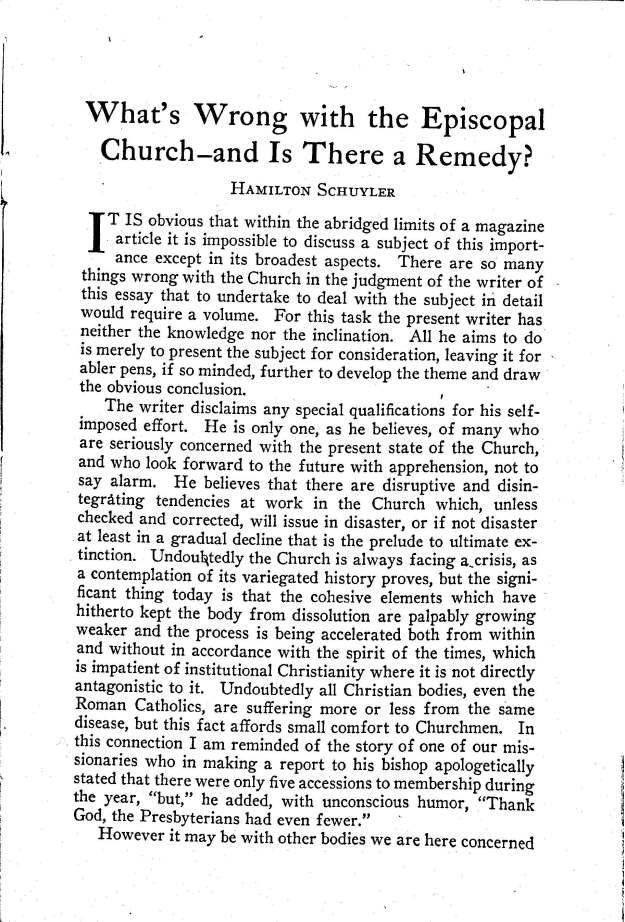
What’s Wrong With the Episcopal Church – and Is There a Remedy? Look! Look! Yet another article about the decline of the Episcopal Church. There seems to be an endless number of articles about the decline of the Episcopal Church lately. It seems the church is being attacked from all sides. We have some who argue that the church’s positions on ‘cultural war’ issues are the cause of the decline. Then there are others who argue that the church has lost its way liturgically and, in the process, is driving millennials away. In both cases, the remedy is the same: roll back to some distant past, some lost Eden if you will, and all will be well. Do we need yet another article about the decline of the Episcopal Church? Frankly no. However, this article is different.
This article about the decline of the Episcopal Church was published in 1930. Back then, weren’t the churches filled and thriving because of the 1928 prayer book, gays being in the closet, and women worrying about flowers and staffing the altar guild? Hardly. This article summarizes the discourse of decline circulating in Episcopal circles from the early 1920s onward. The reader will notice that the author makes the point that the Episcopal Church is a niche organization, accounting for just 1% of the United States population. Further, the Episcopal Church appeals to the “classes, not the masses.” Indeed, however, the perception of the church as a place for wealthy people still persists today. The real value of the article, however, lies in its honest discussion of the reported membership statistics. The author suggests that the reported number of church members is bloated and that at least 30% of the total number of adherents could be “written off.” I have a number of articles from the late 1920s and early 1930s that discuss the situation of huge membership rolls and empty pews (1,500 members on the rolls with an ASA of 30).
As many of you know, I am hesitant to share my personal thoughts about the materials I post on my blog. I would honestly rather the reader interact with the materials and come to their own conclusions. However, I have grown tired of reading about the decline of the Episcopal Church. Until we look, speak, and acknowledge our past decline, I find little merit in discussing the decline in the present. It is easy to say we have been in rapid decline since 1974 or 2003 (depending on which event you want to blame). Mind you, the Diocese of Pennsylvania reached its peak in adherents in 1963, while the national church reached its peak in 1965. I find these discussions to be mean-spirited and to be motivated by partisan politics. How do those who attempt to explain the decline of the Episcopal Church today, with the reasons delineated above, explain the decline of the past? Do they even know? Do they even care? For me, the question of decline in the past is an important one.
– mjk
 Philadelphia Studies